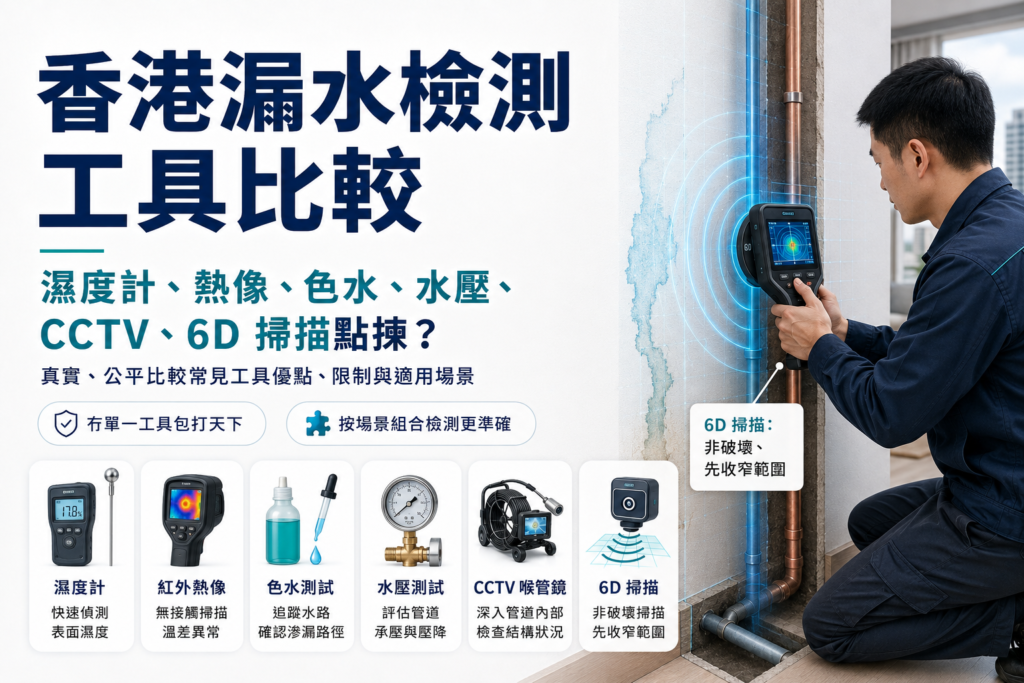
The best instrument is not the one with the most impressive name. It is the method that can answer the current site question with acceptable access, disturbance and uncertainty.
The comparison criteria
A fair comparison considers what the method measures, suitable materials and depth, access, whether it confirms a route or only shows an abnormal pattern, the disturbance involved and how easily another professional can review the record.
Surface moisture and dye methods
Electronic moisture meters are quick for comparing surface or near-surface readings, but “wettest” does not automatically mean “source”. Dye is useful for a selected drainage or waterproofing route, provided the test is controlled and other routes are not mixed into the result.
Flood, spray and pressure tests
Flood or spray testing can reproduce waterproofing or rainwater conditions by zone. Pressure testing is more relevant to supply pipework. Both require suitable isolation, risk control and clear start-and-stop criteria.
Thermal, microwave and spatial scanning
Thermal imaging visualises surface temperature differences; microwave methods examine moisture-related patterns within suitable materials; 6D scanning focuses on broader spatial recording and comparison. None should be described as seeing through every wall or directly identifying every cause.
Match combinations to the symptom
Rain-only window seepage, shower-linked bathroom leakage, persistent pipe concerns and recurring repairs call for different combinations. Start with site history and use a second method when it can distinguish between competing explanations.
Avoid “selling the instrument”
A responsible provider explains why a method is selected, what it can observe, what it cannot prove and what would justify the next step. The deliverable should connect readings to locations and decisions—not provide unexplained images alone.
Frequently asked questions
Is 6D scanning always more accurate than thermal imaging?
No. They observe different information. Accuracy depends on the question, material, access and interpretation.
Can thermal imaging see through a wall?
No. It shows surface temperature patterns that may support an investigation.
Why use more than one method?
Cross-checking is useful when one observation has several possible causes. Every added test should have a defined purpose.
Editorial note: This general educational article does not replace a site inspection, engineering assessment, statutory advice or a confirmed service scope. Applicable requirements and site conditions should be checked for the current project.