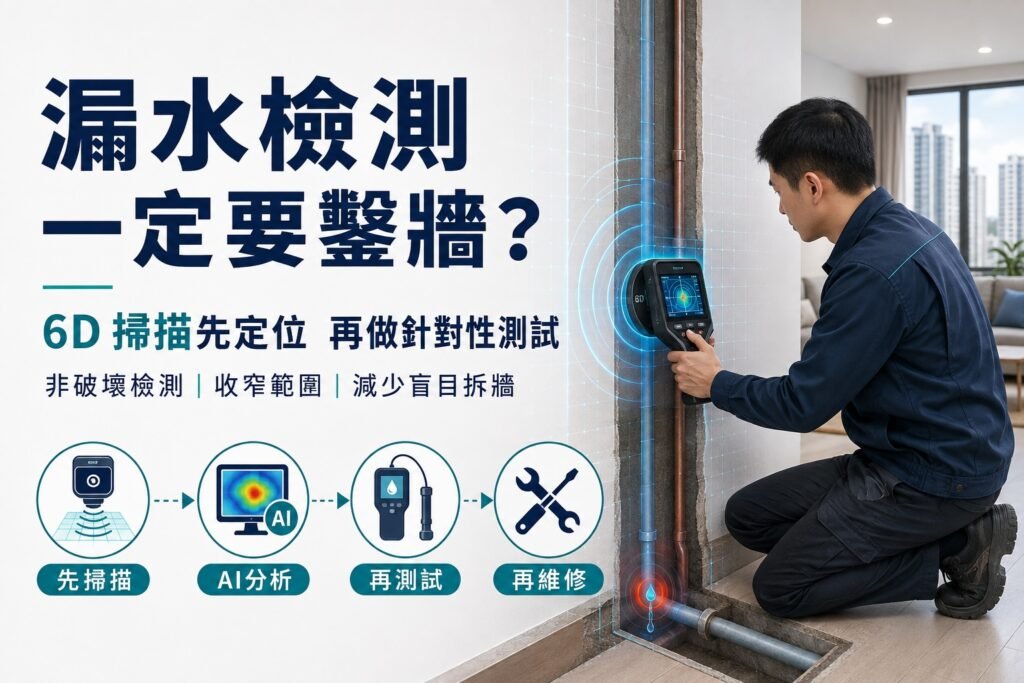
Opening finishes is sometimes necessary, but it should not be the automatic first move. A spatially organised scan can help teams compare normal and suspicious areas before selecting a smaller, more purposeful test or opening location.
What “6D digital imaging” means in this workflow
The method combines location-based site records and sensing data into a spatial view for comparison. AI can assist with pattern organisation, while the interpretation still depends on material, depth, access, site history and professional judgement.
A five-stage investigation sequence
The sequence is: document the symptom; scan the defined area; compare and analyse patterns; perform targeted verification where required; and relate the findings to a repair and follow-up plan. Each stage should answer a specific question.
Situations where broader scanning may help
It can be useful after repeated unsuccessful repairs, where concealed pipework is suspected, when the stain and suspected source do not align, or where the owner wants to reduce unnecessary damage before deciding where to open.
Why targeted testing may still follow
A scan can identify or narrow an abnormal pattern, but different causes can produce similar signals. Controlled water, pressure, moisture or local-access checks may be needed to distinguish the possibilities.
The practical value for an owner
The value is not a promise of zero disturbance or instant certainty. It is a clearer record of where evidence is concentrated, why a next test is proposed and how the repair team can focus its work.
Frequently asked questions
Does 6D scanning guarantee that no wall or tile will be opened?
No. It aims to narrow the investigation first; confirmation and repair may still require local access.
Does a scan identify the source with 100% certainty?
No. Site conditions and materials create limitations, and findings may need targeted verification.
Is it suitable for every property?
Suitability depends on access, construction, the suspected depth and the decision the information must support.
Editorial note: This general educational article does not replace a site inspection, engineering assessment, statutory advice or a confirmed service scope. Applicable requirements and site conditions should be checked for the current project.